🎯 Learning Outcomes
- Relate plant structures (roots, stems, leaves) to transport functions.
- Compare vascular tissue arrangements in Monocots and Dicots.
- Demonstrate the uptake of water and mineral salts.
- Analyse factors affecting the rate of transpiration.
- Describe the process of translocation of manufactured food.
- Practice responsible environmental care during experimentation.
🌿 Monocots vs. Dicots
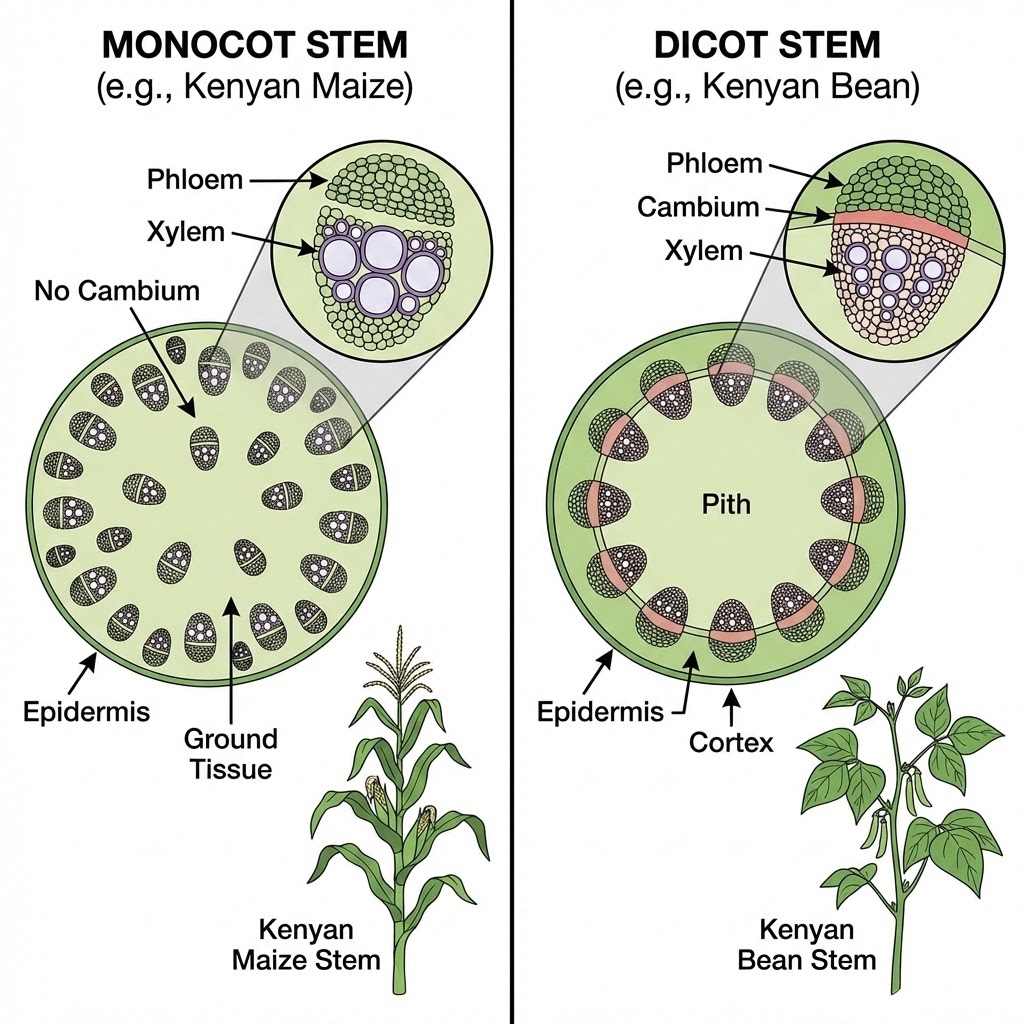
Vascular bundles (Xylem and Phloem) are organized differently depending on the type of plant. These patterns are best seen in stem cross-sections:
| Feature | Monocotyledonous (Monocots) | Dicotyledonous (Dicots) |
|---|---|---|
| Vascular Bundles | Scattered throughout the ground tissue. | Arranged in a distinct ring. |
| Cambium | Absent (No secondary growth). | Present (Allows for thickening/woodiness). |
| Pith | Usually absent. | Present at the center of the stem. |
Grade 10 CBE Kenyan Examples & Practical Notes:
- Monocots: Maize, sorghum, wheat, sugarcane, bananas — scattered vascular bundles → no secondary thickening; stems remain soft/herbaceous; very important Kenyan food crops.
- Dicots: Beans, groundnuts, coffee, tea, mango, acacia trees — ring arrangement + cambium → allows secondary growth (wood formation); many become woody shrubs/trees.
- Lab activity: Cut transverse sections of maize (monocot) and bean stem (dicot) → observe under hand lens/microscope → draw vascular bundles → note scattered vs ring pattern.
- Misconception to correct: "All plants have woody stems" — no, only dicots with cambium show secondary growth; monocots (most Kenyan cereals) do not.
💧 Water and Mineral Uptake
Water moves from the soil to the leaves through the Xylem. This movement is driven by three main physical forces:
Grade 10 CBE Kenyan Examples & Practical Notes:
- Root pressure: Causes guttation (water droplets on leaf tips) in maize/beans early morning — visible in Kenyan farms after cool nights.
- Transpiration pull (cohesion-tension): Main force in tall acacia trees or eucalyptus — continuous water column from roots to leaves pulled by evaporation.
- Root hairs: Increase surface area for water/mineral absorption — abundant in maize, beans; damaged by drought or poor soil → wilting.
- Lab activity: Place celery stalk or maize leaf in coloured water (eosin/red ink) → observe dye rise in xylem → cut transverse section → see coloured vascular bundles.
- Misconception to correct: "Plants suck water like a straw" — no, transpiration pull from leaves creates tension; root pressure is minor in most plants.
🌬️ Transpiration
Transpiration is the loss of water vapor from plant parts, mainly through the stomata of the leaves.
- High Temperature: Increases the kinetic energy of water molecules.
- Low Humidity: Increases the concentration gradient between the leaf and air.
- Wind Speed: Blows away saturated air from the leaf surface.
- High Light Intensity: Causes stomata to open for photosynthesis.
Grade 10 CBE Kenyan Context & Practical Notes:
- High temperature & low humidity: Common in arid/semi-arid areas (Kitui, Machakos, Kajiado) → high transpiration → plants wilt if water uptake can't match loss.
- Wind: Increases rate in open fields (e.g., tea estates in Kericho) → farmers use windbreaks or mulching to reduce water loss.
- Light: Stomata open in light → more transpiration during sunny days; important for maize/sorghum in rainy season.
- Lab/field activity: Use potometer (or simple setup with leafy shoot in tube) → measure water uptake rate under different conditions (fan = wind, lamp = light, plastic bag = high humidity) → graph results.
- Misconception to correct: "Transpiration is only water loss" — no, it's essential: cools plant, drives mineral transport, maintains turgor; excessive loss causes wilting.
🚚 Translocation
Unlike water, manufactured food (sucrose) is transported through the Phloem. This process is called Translocation and can occur in any direction—from "source" (leaves) to "sink" (roots, fruits, or growing tips).
Grade 10 CBE Kenyan Examples & Practical Notes:
- Source → sink: In maize — leaves (source) send sucrose to developing grains (sink); in beans — to pods/seeds; in sugarcane — to storage stems.
- Ringing experiment: Classic proof — phloem carries food down; xylem (inside ring) carries water up → part above ring stays green (water reaches it) but swells (food accumulates).
- Lab activity: Perform ringing on young bean/maize plant (with teacher supervision) → observe swelling above ring after days → compare with control plant.
- Misconception to correct: "Phloem only moves food down" — no, translocation is bidirectional — from leaves to roots, to fruits, to growing tips depending on plant needs.
❓ Inquiry Question
Answer: Plants use a specialized vascular system. Xylem vessels transport water and minerals upwards via transpiration pull and capillarity. Phloem tubes transport sucrose and amino acids through translocation, distributing energy to all living parts of the plant.