🎯 Learning Outcomes
- Describe autotrophic and heterotrophic nutrition in plants.
- Relate the structure of the chloroplast to its specific function.
- Illustrate the light and dark stages of photosynthesis.
- Appreciate the global significance of plant nutrition.
🍎 Types of Nutrition in Plants
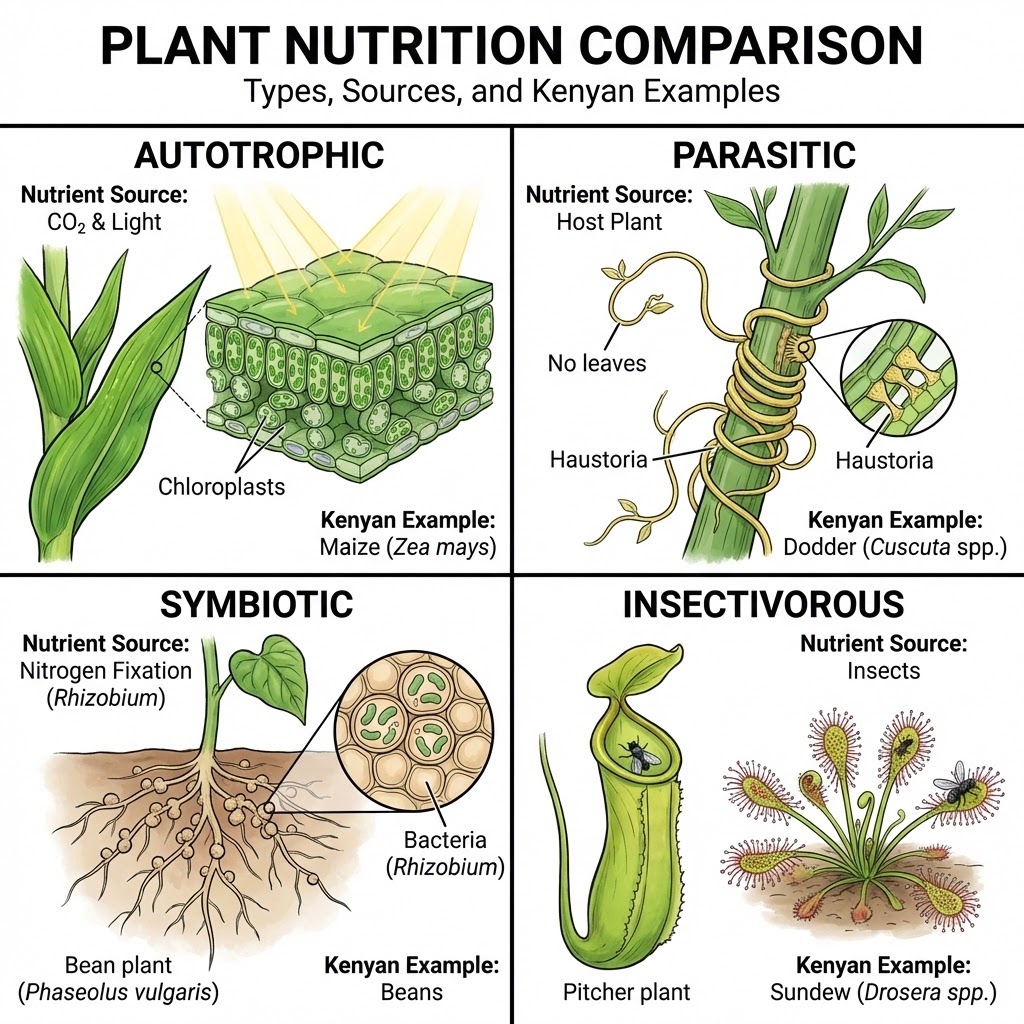
While most plants are Autotrophic (making their own food), some have adapted different strategies to survive in nutrient-poor environments.
| Nutrition Type | Mechanism | Example |
|---|---|---|
| Autotrophic | Photosynthesis using chlorophyll. | Green plants, Algae |
| Parasitic | Absorbing nutrients from a living host. | Dodder plant (Cuscuta) |
| Saprophytic | Feeding on dead/decaying organic matter. | Some non-green plants/fungi |
| Symbiotic | Mutual benefit between two organisms. | Rhizobium in root nodules |
| Insectivorous | Trapping insects for Nitrogen. | Venus Flytrap, Pitcher plant |
Grade 10 CBE Kenyan Examples & Ecological Notes:
- Autotrophic: Most Kenyan crops (maize, beans, sorghum, sugarcane) — use photosynthesis to produce glucose from CO₂, water, and sunlight.
- Parasitic: Dodder (Cuscuta) on acacia or crops — yellow/orange stems wrap around host → steals water and nutrients; major problem in some Kenyan farms.
- Symbiotic: Legumes (beans, groundnuts, soybeans) with Rhizobium bacteria in root nodules → fix atmospheric nitrogen → improves soil fertility (common intercropping practice).
- Insectivorous: Sundew, bladderwort (rare in Kenya) — trap insects to get nitrogen in nutrient-poor soils (e.g., bogs/wetlands).
- Field activity: Dig up bean/maize roots → look for pink/red nodules (nitrogen fixation); observe dodder on roadside plants → discuss impact on agriculture.
- Misconception to correct: "All plants make their own food" — no, parasitic and some saprophytic plants depend on others; insectivorous plants supplement photosynthesis with nitrogen from prey.
🍃 The Chloroplast Structure
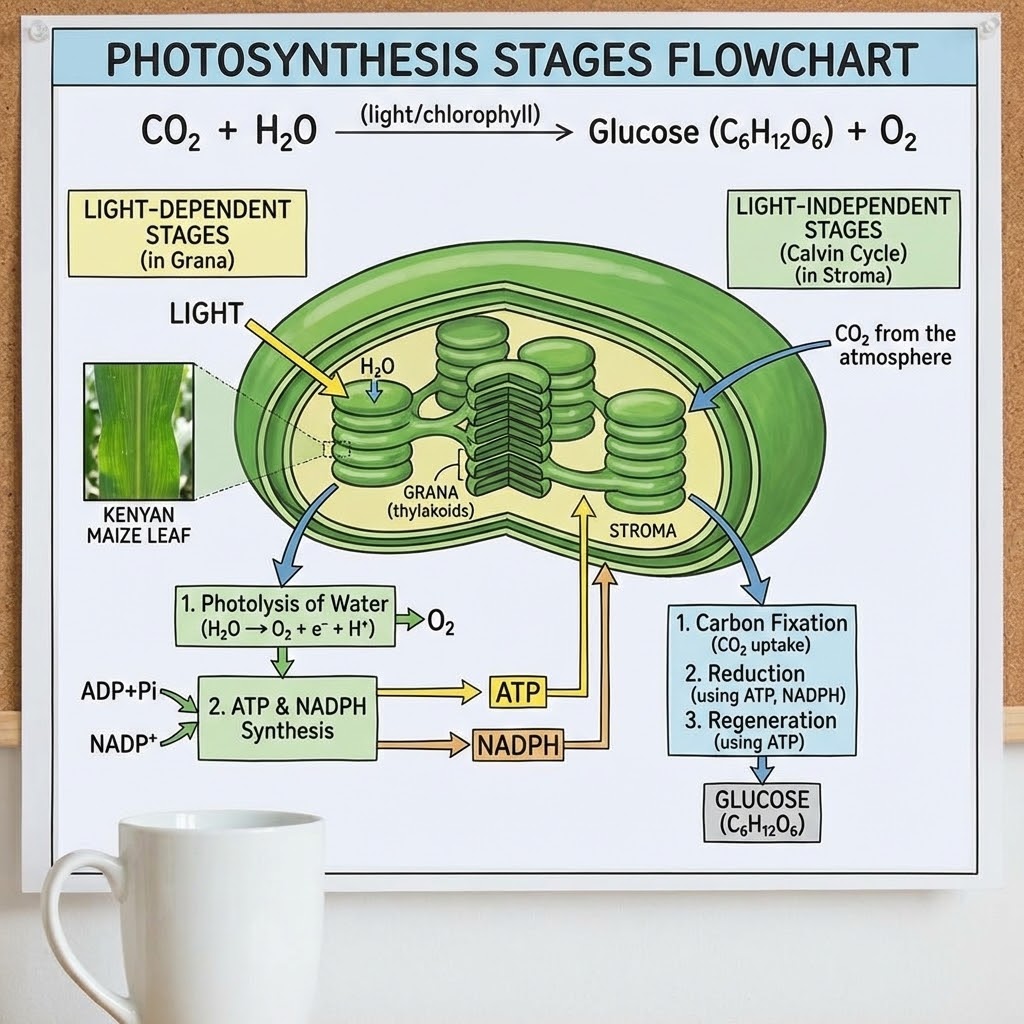
The chloroplast is the site of photosynthesis. Its structure is perfectly adapted to maximize energy capture:
Thylakoid Membranes: Stacked into Grana. They contain chlorophyll to trap light energy for the Light Stage.
Stroma: A fluid-filled matrix containing enzymes. This is the site for the Dark Stage (Calvin Cycle).
Adaptation: The double membrane regulates the movement of gases and nutrients, while the large surface area of grana ensures maximum light absorption.
Grade 10 CBE Kenyan Context & Practical Notes:
- Grana & thylakoids: Chlorophyll in thylakoid membranes captures sunlight → most abundant in palisade mesophyll of maize/sorghum leaves (top layers get max light).
- Stroma: Contains enzymes for Calvin cycle → fixes CO₂ into glucose; also has own DNA and ribosomes (endosymbiotic origin theory).
- Lab activity: Prepare Elodea or maize leaf section → observe chloroplasts under microscope (green dots); add iodine → starch grains appear blue-black (product of photosynthesis).
- Misconception to correct: "Chloroplasts are only in leaves" — no, also in green stems (e.g., young maize stems) and some fruits; but most photosynthesis occurs in leaves.
☀️ The Process of Photosynthesis
Photosynthesis occurs in two distinct but interdependent stages. The overall chemical word equation is:
Carbon Dioxide + Water —(Light/Chlorophyll)—> Glucose + Oxygen
1. Light-Dependent Stage:
Occurs in the Grana. Light energy splits water molecules (Photolysis) into Hydrogen ions and Oxygen. ATP is generated.
Occurs in the Grana. Light energy splits water molecules (Photolysis) into Hydrogen ions and Oxygen. ATP is generated.
2. Light-Independent (Dark) Stage:
Occurs in the Stroma. Carbon dioxide is "fixed" using Hydrogen and ATP from the light stage to form Glucose.
Occurs in the Stroma. Carbon dioxide is "fixed" using Hydrogen and ATP from the light stage to form Glucose.
Grade 10 CBE Kenyan Context & Practical Notes:
- Light stage: In grana — photolysis produces O₂ (released through stomata), ATP, and NADPH → fuels dark stage; occurs only in light.
- Dark stage (Calvin cycle): In stroma — CO₂ fixed by RuBisCO enzyme into glucose → can occur in dark if ATP/NADPH available; main product stored as starch in maize grains.
- Importance in Kenya: Photosynthesis produces food (maize, beans, tea, coffee) — basis of economy; also produces O₂ and sequesters CO₂ (forests, wetlands help mitigate climate change).
- Lab activity: Test leaf for starch — cover part of leaf with black paper → expose to light → test with iodine → starch only where light reached (proves light needed).
- Misconception to correct: "Dark stage only happens at night" — no, it's called "dark" because it doesn't require light directly; it runs in light (uses products of light stage) and can continue briefly in dark.
❓ Inquiry Question
"How do plants obtain food?"
Answer: Plants primarily obtain food through Autotrophic Nutrition. Using the chloroplasts in their leaves, they convert solar energy into chemical energy (Glucose). However, specialized plants may use heterotrophic methods to supplement nutrients like Nitrogen.
Answer: Plants primarily obtain food through Autotrophic Nutrition. Using the chloroplasts in their leaves, they convert solar energy into chemical energy (Glucose). However, specialized plants may use heterotrophic methods to supplement nutrients like Nitrogen.
🧩 Knowledge Check
1. In which specific part of the chloroplast does the Light-Independent (Dark) stage take place?
2. What is the name of the process where water molecules are split by light energy?