🎯 Learning Outcomes
- Analyse the structure and adaptations of gaseous exchange sites in aquatic and terrestrial plants.
- Examine the mechanism of stomatal movement via the Potassium Ion (K+) Theory.
- Compare Aerobic and Anaerobic respiration efficiency.
- Implement a fermentation project to demonstrate the economic value of anaerobic respiration.
🌬️ Gaseous Exchange Sites
Plants must exchange Carbon Dioxide (CO₂) and Oxygen (O₂) with their surroundings. These sites are adapted to their specific habitats:
| Site | Habitat | Key Adaptation |
|---|---|---|
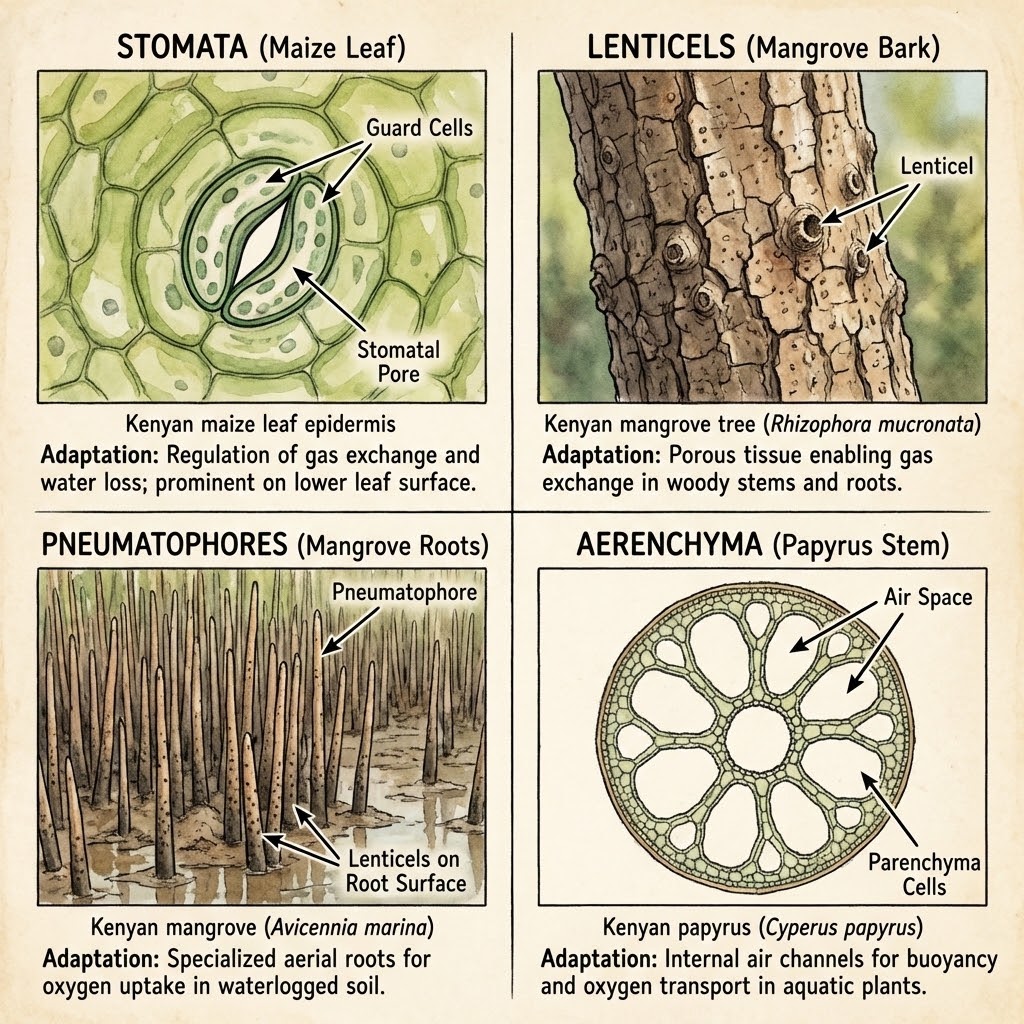
| Stomata | Terrestrial | Located on the leaf underside to reduce excessive water loss. |
| Lenticels | Woody Stems | Permanently open pores in the bark for oxygen entry to inner living tissues. |
| Pneumatophores | Mangrove/Swamp | Vertical roots that grow above water level to escape anaerobic mud. |
| Large Aerenchyma | Aquatic (Floating) | Large air spaces that facilitate gas diffusion and provide buoyancy. |
Grade 10 CBE Kenyan Examples & Practical Notes:
- Stomata: On maize, sorghum, beans leaves — mostly on underside → reduces transpiration in hot Kenyan sun; guard cells control opening/closing.
- Lenticels: On tree stems (e.g., acacia, mango) — allow oxygen to reach inner bark even when leaves are shed in dry season.
- Pneumatophores: In Kenyan mangroves (e.g., Gazi Bay, Tudor Creek) — "breathing roots" rise above mud to take in air in waterlogged, low-oxygen soils.
- Aerenchyma: In water lilies, papyrus (around Lake Victoria) — large air spaces store oxygen and help float in water.
- Field/lab activity: Observe leaf underside (maize) with hand lens → count stomata density; cut transverse section of pneumatophore or papyrus stem → show air spaces.
- Misconception to correct: "Plants only take in CO₂ and give out O₂" — no, plants do both respiration (take O₂, give CO₂) and photosynthesis (take CO₂, give O₂); net O₂ production occurs in light.
⚙️ Theories of Stomatal Movement
Stomatal opening depends on the **Turgidity** of the guard cells. The most widely accepted modern explanation is the **Potassium Ion Theory**:
Mechanism of Opening (Daytime):
- Light triggers the active transport of Potassium Ions (K+) into the guard cells.
- The accumulation of K+ ions lowers the water potential inside the guard cells.
- Water moves into the guard cells by osmosis from neighboring epidermal cells.
- Guard cells become Turgid, swell, and curve outward, opening the pore.
At night, the process reverses: K+ ions exit, water leaves by osmosis, and cells become Flaccid, closing the pore.
Grade 10 CBE Kenyan Context & Practical Notes:
- Light trigger: Blue light activates proton pumps → K⁺ influx → turgor increase → stomata open for CO₂ entry during photosynthesis (maize, sugarcane fields).
- Water conservation: In dry areas (e.g., Kitui, Kajiado), stomata close during hottest hours → reduces transpiration; CAM plants (e.g., some succulents) open stomata at night.
- Lab activity: Use cobalt chloride paper on leaf surface → blue → pink faster on upper surface (fewer stomata) vs lower → demonstrates stomatal distribution.
- Misconception to correct: "Stomata are always open" — no, they open in light (photosynthesis) and close in dark or drought to prevent water loss.
🔋 Respiration: Chemical Energy Release
Respiration is the metabolic process where cells produce Energy (ATP). It is categorized based on the presence of Oxygen:
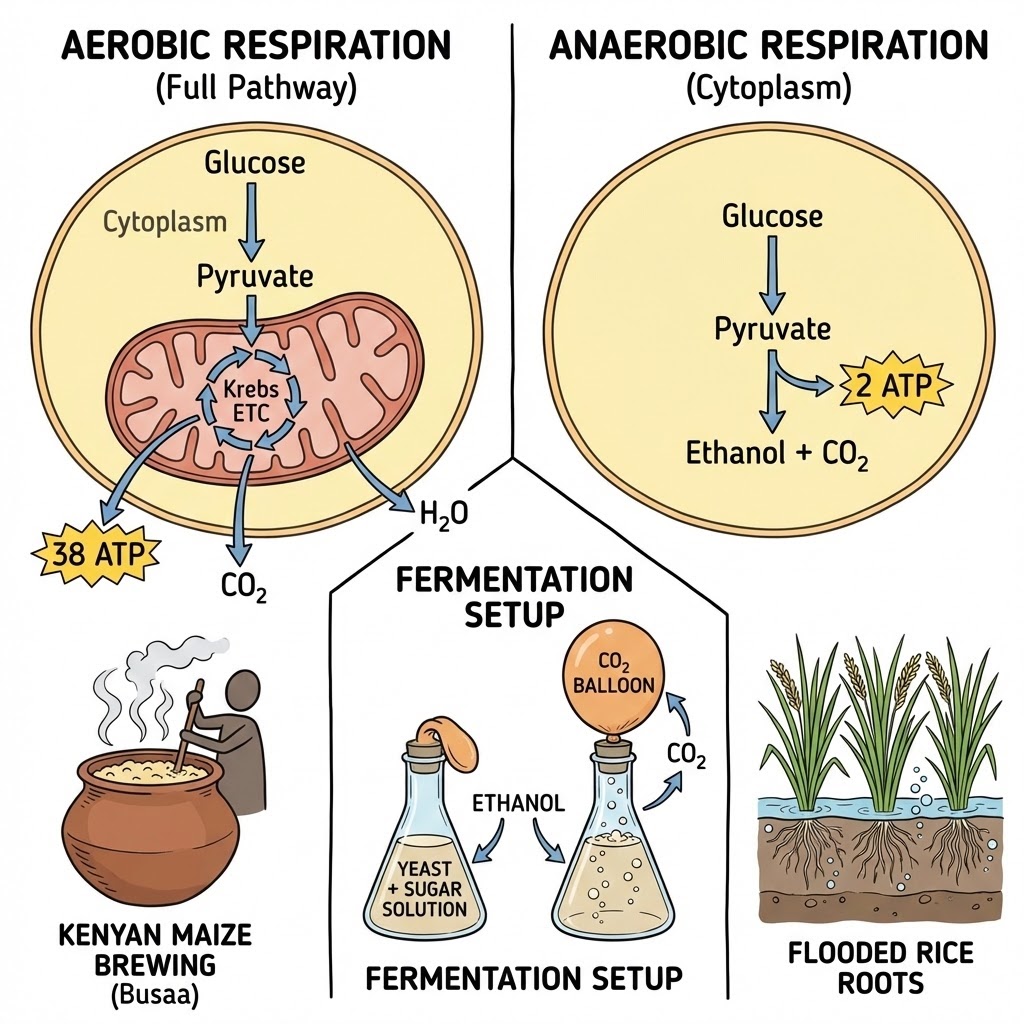
Aerobic: C6H12O6 + 6O2 → 6CO2 + 6H2O + 38 ATP
Aerobic Respiration:
Occurs in Mitochondria. Complete breakdown of glucose. Produces high energy and non-toxic waste (CO2 and H2O).
Occurs in Mitochondria. Complete breakdown of glucose. Produces high energy and non-toxic waste (CO2 and H2O).
Anaerobic Respiration:
Occurs in Cytoplasm. Incomplete breakdown. In plants, it produces Ethanol and CO2. This is used in the brewing and baking industries.
Occurs in Cytoplasm. Incomplete breakdown. In plants, it produces Ethanol and CO2. This is used in the brewing and baking industries.
Grade 10 CBE Kenyan Examples & Practical Notes:
- Aerobic: In plant roots, leaves — full 38 ATP/glucose; requires O₂ from stomata/lenticels.
- Anaerobic: In flooded roots (rice paddies, papyrus swamps) — ethanol + CO₂ produced; also in brewing chang'aa (maize fermentation) and baking (yeast in mandazi/nyama choma bread).
- Efficiency: Aerobic = 38 ATP (high), anaerobic = 2 ATP (low) — plants avoid anaerobic when possible due to toxic ethanol buildup.
- Project idea: Yeast fermentation — mix yeast + sugar + warm water in bottle + balloon → balloon inflates (CO₂) → compare with boiled yeast (no fermentation).
- Misconception to correct: "Plants only photosynthesize" — no, plants respire 24/7; photosynthesis only in light; net O₂ production occurs during day.
❓ Inquiry Question
"How is respiration useful to plants?"
Answer: Respiration provides the chemical energy (ATP) necessary for all vital processes, including active transport of minerals, cell division (growth), and the synthesis of complex molecules like proteins and lipids.
Answer: Respiration provides the chemical energy (ATP) necessary for all vital processes, including active transport of minerals, cell division (growth), and the synthesis of complex molecules like proteins and lipids.
🧩 Knowledge Check
1. In the equation for aerobic respiration, what is the chemical formula for the sugar being broken down?
2. Which specific ion is actively transported into guard cells to cause stomatal opening?