🎯 Learning Outcomes
- Explain the application of Biology in everyday life.
- Relate fields of study to career opportunities.
- Illustrate specific careers within Biological sciences.
- Appreciate the importance of Biology in solving global issues.
🌿 Biology in Everyday Life
Biology is not just a school subject; it is the science of life. We apply it daily in several key areas:
Real-World Applications
Agriculture & Nutrition:
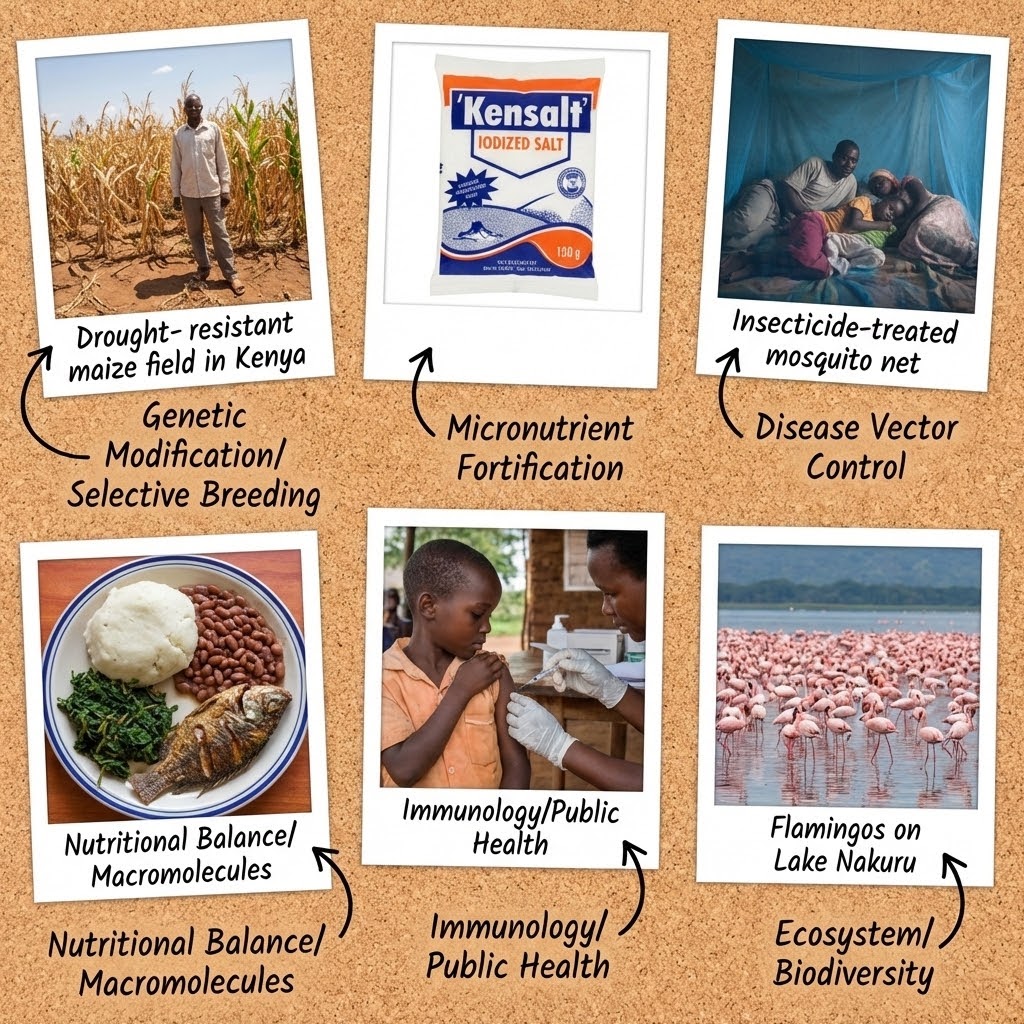
Example: Developing drought-resistant crops or understanding balanced diets to prevent scurvy or rickets.
Example: Developing drought-resistant crops or understanding balanced diets to prevent scurvy or rickets.
Health & Medicine:
Example: Understanding how vaccines stimulate the immune system to fight viruses like Polio or COVID-19.
Example: Understanding how vaccines stimulate the immune system to fight viruses like Polio or COVID-19.
Grade 10 CBE Kenyan Context & Everyday Examples:
- Agriculture: Biology helps develop drought-resistant maize varieties (e.g., Katumani, Makueni hybrids) used by farmers in arid areas like Kitui and Machakos.
- Nutrition & public health: Understanding balanced diets prevents kwashiorkor (protein deficiency) and marasmus; iodized salt prevents goitre — both major campaigns in Kenya.
- Medicine & disease control: Biology explains how mosquitoes transmit malaria → use of bed nets, indoor spraying, and vaccines (RTS,S) reduces cases in endemic areas like the coast and lake regions.
- Environment: Understanding ecosystems helps conserve forests (e.g., Mau Forest) and wetlands (e.g., Lake Nakuru flamingos) — vital for tourism and climate regulation.
- Misconception to correct: "Biology is only about plants and animals in textbooks" — no, it's behind everyday things: cooking (fermentation of ugali, yoghurt), soap (saponification), composting, and even mobile money safety (hygiene to prevent disease spread).
🔍 Fields of Study & Career Paths
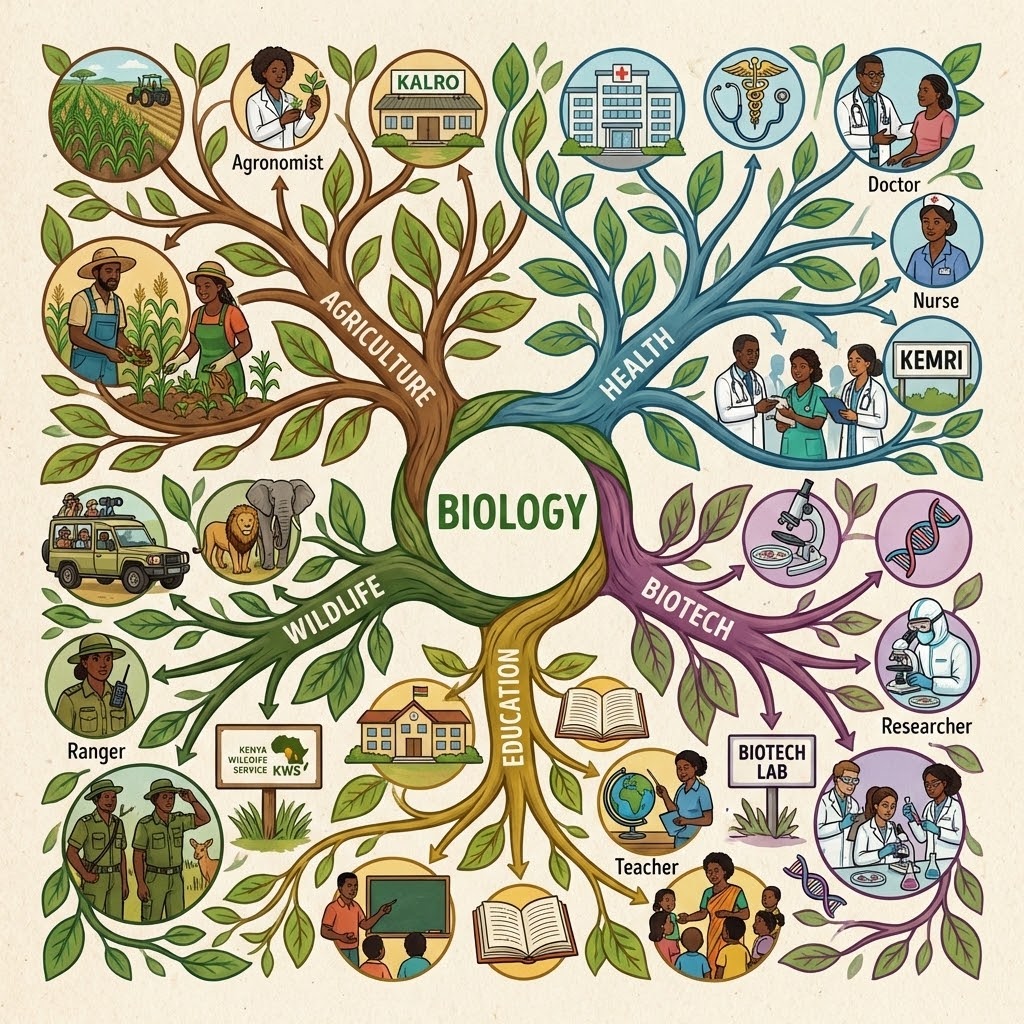
Biology is a vast umbrella. Here is how specific branches translate into professional careers:
| Field of Study | Focus Area | Related Career |
|---|---|---|
| Botany | Study of plants | Plant Breeder, Agronomist |
| Zoology | Study of animals | Wildlife Biologist, Vet |
| Anatomy | Internal structures | Surgeon, Physiotherapist |
| Microbiology | Microscopic organisms | Bacteriologist, Lab Tech |
| Genetics | Heredity and Variation | Genetic Counselor, Forensic Scientist |
| Biotechnology | Using living systems for products | Biomedical Engineer, Vaccine Researcher |
Grade 10 CBE Kenyan Career Inspiration & Opportunities:
- Agriculture-related: Agronomist, plant breeder — vital for food security; jobs at KALRO, seed companies, county agriculture offices.
- Health & medicine: Doctor, nurse, pharmacist, lab technologist — high demand in public/private hospitals, NHIF, KEMRI.
- Wildlife & conservation: Wildlife biologist, ranger, tour guide — opportunities in KWS, national parks, conservancies (Maasai Mara, Tsavo).
- Biotechnology & research: Geneticist, microbiologist — emerging field; jobs at universities, biotech startups, vaccine production (e.g., COVID-19 response).
- Breaking barriers: Girls/women encouraged — many Kenyan women now excel as veterinarians, researchers, conservationists (e.g., Wangari Maathai legacy).
- Activity idea: Students research one career → interview a professional (parent/relative) or watch YouTube → present how biology is used daily in that job.
💡 Choosing a Career
Choosing a career in Biology should be based on Interest and Ability. It is essential to break down barriers that limit choices:
Note: Factors like gender, culture, disability, or environment should never limit your potential to become a scientist. Science thrives on diversity!
Grade 10 CBE Motivation & Real Kenyan Stories:
- Diversity in science: Many Kenyan women now lead in STEM — e.g., veterinarians treating livestock in rural areas, researchers developing malaria vaccines.
- Overcoming barriers: Students from arid regions (e.g., Turkana, Garissa) can study biology → become agricultural extension officers helping communities farm better.
- Global impact: Biology careers help solve Kenyan challenges: food insecurity, climate change, emerging diseases (e.g., Rift Valley Fever, antimicrobial resistance).
- Advice: Join biology clubs, attend career fairs, shadow professionals, read about scientists like Prof. Calestous Juma (biotechnology) or Dr. Tecla Temu (public health).
❓ Inquiry Question
"Why is it important to study Biology?"
Answer: Studying Biology allows us to understand the interdependence of living things, manage natural resources sustainably, improve food security, and combat diseases. It provides the foundation for solving environmental and health crises.
Answer: Studying Biology allows us to understand the interdependence of living things, manage natural resources sustainably, improve food security, and combat diseases. It provides the foundation for solving environmental and health crises.
🧩 Knowledge Check
1. Which field of Biology would a person study if they wanted to become a Surgeon?
2. What is the study of heredity and the variation of inherited characteristics?