🎯 Learning Outcomes
- Describe the composition and functions of carbohydrates, lipids, and proteins.
- Conduct experiments to identify nutrients in food substances.
- Investigate the properties and factors affecting enzyme activity.
- Appreciate the role of water, vitamins, and minerals in cell metabolism.
🧪 The Core Chemicals
Cells are built from and powered by organic molecules. Each has a specific elemental composition and role:
| Chemical | Elements | Primary Functions |
|---|---|---|
| Carbohydrates | Carbon, Hydrogen, Oxygen | Immediate energy source (Glucose), Storage (Starch/Glycogen). |
| Lipids (Fats) | Carbon, Hydrogen, Oxygen | Long-term energy storage, Insulation, Component of cell membranes. |
| Proteins | C, H, O, Nitrogen, (Sulphur) | Growth, Tissue repair, Formation of enzymes and antibodies. |
| Vitamins (e.g., C) | Diverse | Co-enzymes; Vitamin C is vital for collagen synthesis and immunity. |
Grade 10 CBE Kenyan Examples & Nutritional Context:
- Carbohydrates: Ugali (maize starch), rice, bananas, sugarcane — main energy source in Kenyan diets; excess stored as glycogen in liver/muscles.
- Lipids: Avocado, groundnuts, cooking oil, fatty meat — high energy (9 kcal/g vs 4 kcal/g for carbs/proteins); essential for cell membranes and vitamin absorption.
- Proteins: Beans, nyama choma, fish, eggs, milk — growth & repair; amino acids used to build enzymes, haemoglobin, antibodies.
- Vitamins & minerals: Vitamin C (oranges, mangoes — prevents scurvy), iron (ugali + spinach — prevents anaemia), calcium (milk, sukuma wiki — bones/teeth).
- Misconception to correct: "Fats are always bad" — no, essential fats (e.g., omega-3 in fish) are vital; excess saturated fats from fried foods increase health risks.
🔬 Experimental Food Tests
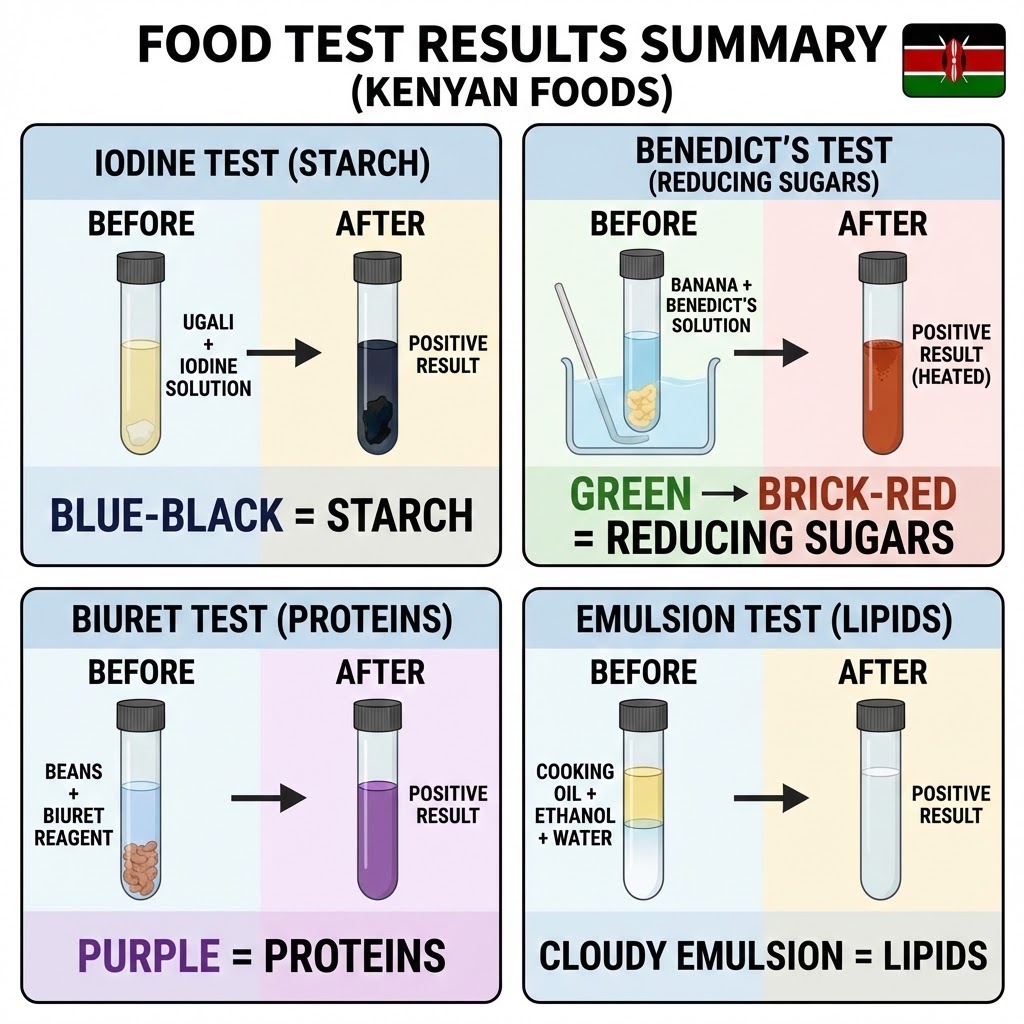
To identify these chemicals in the lab, we use specific chemical indicators. Note the color changes:
Starch Test:
Indicator: Iodine Solution
Positive Result: Blue-Black color.
Indicator: Iodine Solution
Positive Result: Blue-Black color.
Reducing Sugars:
Indicator: Benedict's Solution + Heat
Positive Result: Orange/Brick-Red precipitate.
Indicator: Benedict's Solution + Heat
Positive Result: Orange/Brick-Red precipitate.
Proteins:
Indicator: Biuret Test (NaOH + CuSO₄)
Positive Result: Purple/Violet color.
Indicator: Biuret Test (NaOH + CuSO₄)
Positive Result: Purple/Violet color.
Lipids:
Test: Emulsion Test (Ethanol + Water)
Positive Result: Cloudy White Emulsion.
Test: Emulsion Test (Ethanol + Water)
Positive Result: Cloudy White Emulsion.
Grade 10 CBE Kenyan Lab Examples & Safety:
- Common foods tested: Ugali/maize flour (starch — blue-black with iodine), banana/mango (reducing sugars — brick-red with Benedict's), beans/egg white (proteins — purple with Biuret), cooking oil/avocado (lipids — cloudy emulsion).
- Safety: Wear goggles, handle hot water/Benedict's carefully, avoid tasting chemicals, dispose waste properly (not in sink).
- Lab activity: Test mystery food samples (e.g., ugali, milk, cooking oil) → record results → identify major nutrient(s) → discuss balanced diet importance.
- Misconception to correct: "All carbohydrates give positive Benedict's test" — no, only reducing sugars (glucose, fructose, maltose); starch and sucrose do not (non-reducing).
⚡ Enzymes: Biological Catalysts
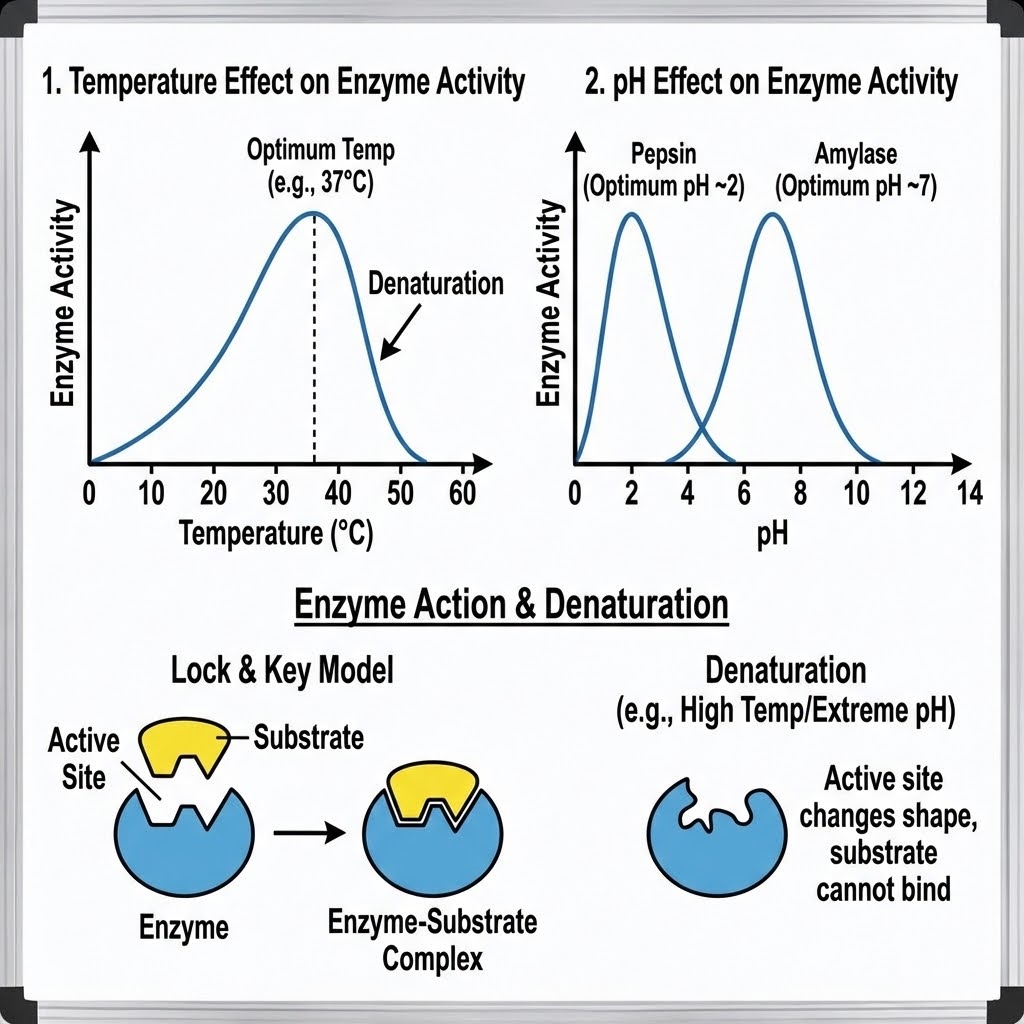
Enzymes are specialized proteins that speed up chemical reactions without being consumed. An example is Catalase, found in living tissues (like liver or potato), which breaks down toxic Hydrogen Peroxide into water and oxygen.
Factors Affecting Enzyme Activity:
- Temperature: Activity increases with temp up to the Optimum (approx 37°C), then drops as the enzyme denatures.
- pH: Each enzyme has an optimum pH (e.g., Pepsin works in acidic pH 2).
- Concentration: Increasing substrate or enzyme concentration increases rate until a saturation point is reached.
Grade 10 CBE Kenyan Examples & Practical Notes:
- Catalase: In raw potato/liver — breaks H₂O₂ → O₂ bubbles (foaming) → shows enzyme activity; cooked sample → no bubbles (denatured).
- Amylase: In saliva — breaks starch → maltose; test with iodine (blue-black → no colour as starch digested).
- Optimum conditions: Human enzymes ~37°C, pH 7 (except pepsin pH 2 in stomach); Kenyan body temperature varies little, but fever denatures enzymes.
- Lab activity: Catalase experiment — add H₂O₂ to fresh vs boiled potato → measure foam height/rate → graph temperature effect (0–70°C).
- Misconception to correct: "Enzymes are used up" — no, they are catalysts — reusable; only denatured by extreme heat/acid/base.
🛒 Life Skills: Analyzing Food Labels
A critical skill is examining packaging. When buying food, consider:
- Preservatives & Colorings: These ensure safety and shelf-life but may affect health in excess.
- Expiry Dates: Chemical components degrade over time, making food unsafe or nutritionally poor.
- Nutritional Value: Ensuring the right balance of proteins, lipids, and vitamins.
Grade 10 CBE Kenyan Context & Consumer Tips:
- Labels on Kenyan products: Check KEBS Diamond Mark (quality assurance), ingredient list (e.g., avoid excess sugar in sodas), nutritional info per 100g.
- Health links: High sugar/fat in snacks → obesity/diabetes risk (rising in urban Kenya); fortified flour (iron, vitamins) helps prevent anaemia.
- Activity idea: Bring food packets to class → read labels → calculate energy (kcal) from carbs/proteins/fats → discuss balanced meal planning (e.g., ugali + beans + greens).
- Misconception to correct: "Natural = healthy" — no, some natural foods high in fat/sugar (e.g., coconut oil, soda); check labels for additives/preservatives.
❓ Inquiry Question
"How is the presence of chemicals of life determined?"
Answer: Presence is determined through Qualitative Food Tests. By using reagents that react chemically with specific molecules (like Benedict's for sugars or Biuret for proteins), we observe distinct color changes that confirm the nutrient's presence.
Answer: Presence is determined through Qualitative Food Tests. By using reagents that react chemically with specific molecules (like Benedict's for sugars or Biuret for proteins), we observe distinct color changes that confirm the nutrient's presence.
🧩 Knowledge Check
1. Which nutrient produces a brick-red precipitate when heated with Benedict's solution?
2. What happens to an enzyme's structure when it is exposed to extremely high temperatures?