🎯 Learning Outcomes
- Distinguish between open, closed, single, and double circulatory systems.
- Describe the pumping mechanism of the mammalian heart.
- Explain the mechanism of blood clotting and lymphatic defense.
- Master the ABO and Rhesus factor blood grouping systems.
- Prepare and analyze blood donor-recipient compatibility charts.
- Practice ethical dissection and humane animal handling.
🔄 Diverse Circulatory Systems
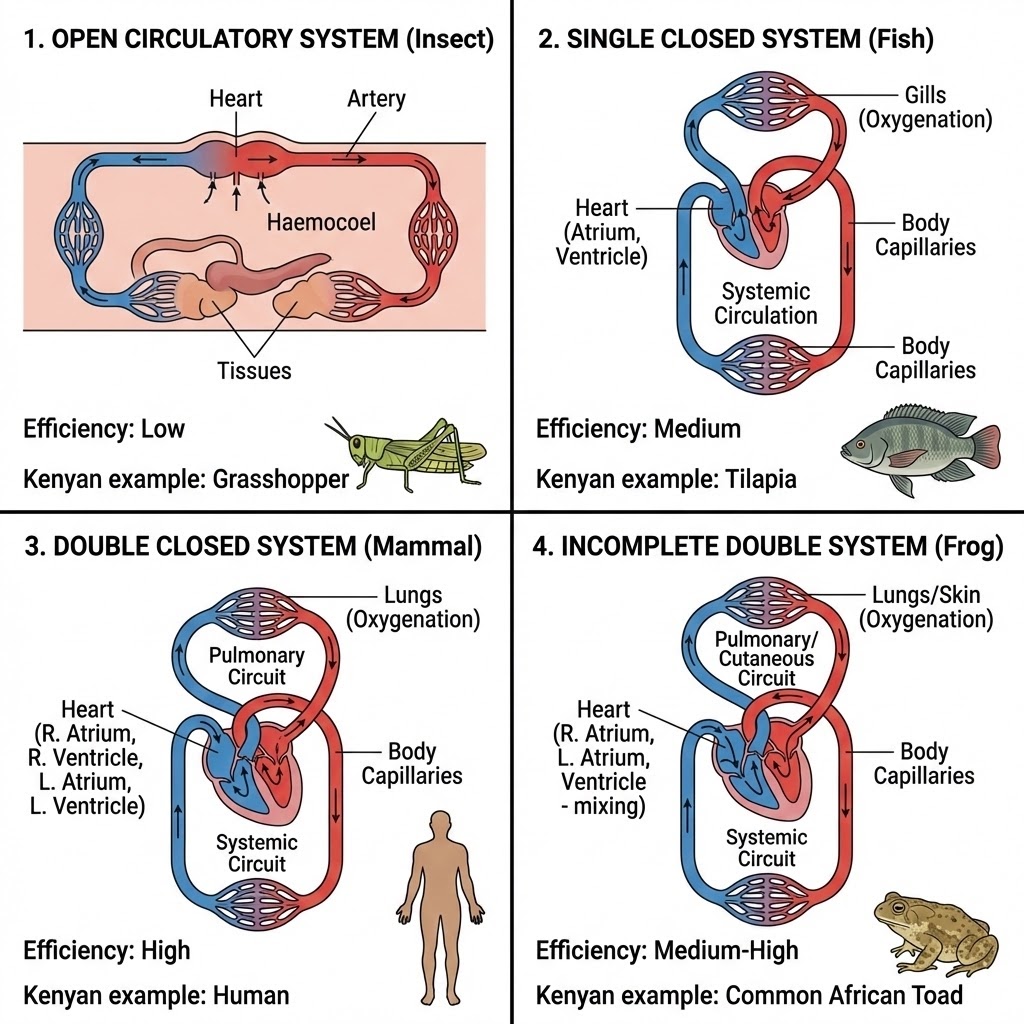
As animals increase in size and complexity, their transport systems evolve to become more efficient:
| System Type | Mechanism | Animal Example |
|---|---|---|
| Open System | Blood (haemolymph) pumps into cavities (haemocoel), bathing organs directly. | Insects (e.g., Grasshopper) |
| Single Closed | Blood passes through the heart once per complete circuit. | Fish (2-chambered heart) |
| Double Closed | Blood passes through the heart twice (Pulmonary and Systemic circuits). | Mammals, Birds |
| Incomplete Double | Three-chambered heart with partial mixing of oxygenated/deoxygenated blood. | Amphibians, Reptiles |
Grade 10 CBE Kenyan Examples & Practical Notes:
- Open system: Insects (grasshoppers, mosquitoes, bees) — haemolymph moves slowly; efficient for small bodies with low oxygen demand.
- Single closed: Fish (tilapia, Nile perch in Kenyan lakes) — blood passes heart once → gills → body → heart; suited to water where oxygen is less available.
- Double closed: Mammals (humans, goats, cows) and birds (eagles, weaver birds) — high metabolic rate needs separate pulmonary (lungs) and systemic (body) circuits for high-pressure delivery of oxygen.
- Incomplete double: Amphibians (frogs in wetlands) — mixing of blood in ventricle → lower efficiency but supplemented by skin breathing.
- Lab activity: Compare diagrams/models of 2-chamber (fish), 3-chamber (frog), 4-chamber (human) hearts → discuss efficiency and oxygen delivery.
- Misconception to correct: "Open circulation is inefficient" — no, it's perfectly suited for small, low-metabolism animals like insects.
❤️ The Pumping Mechanism
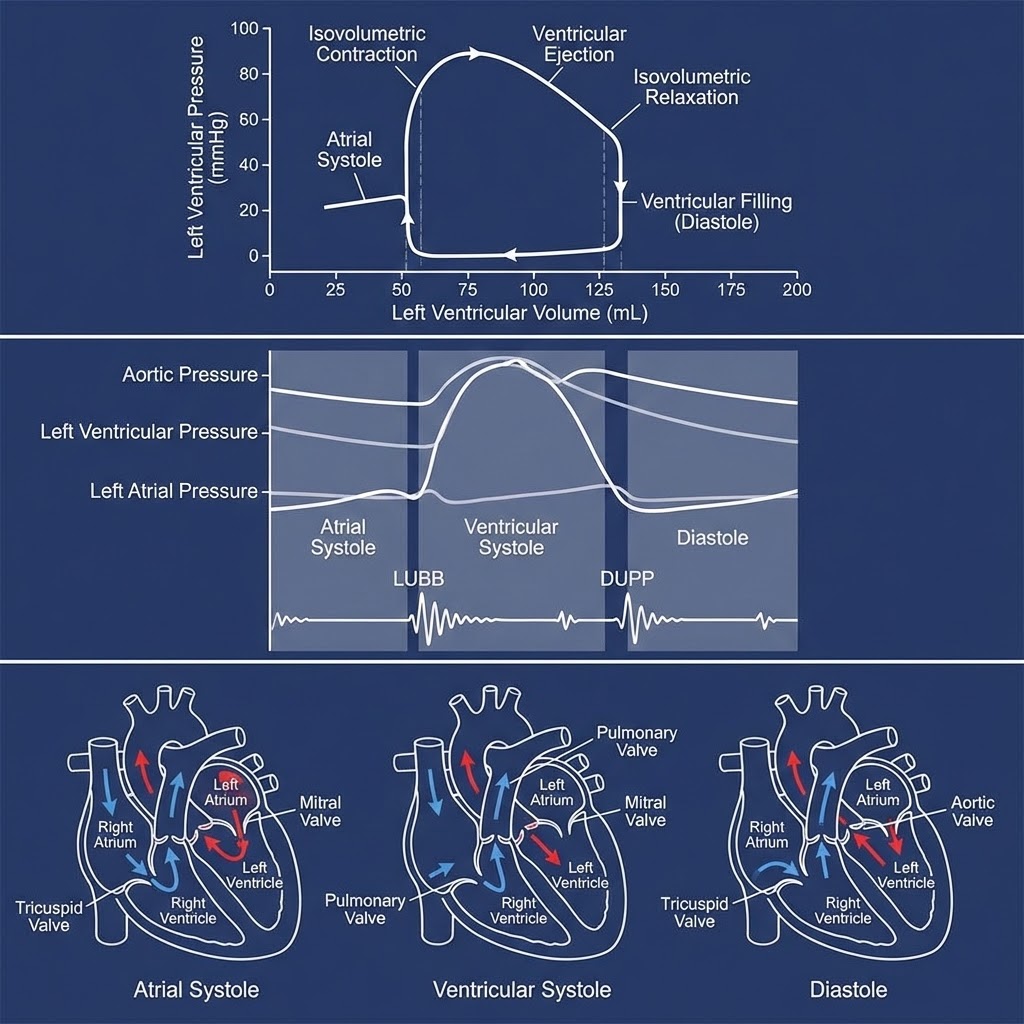
The mammalian heart acts as a dual-pressure pump using rhythmic contractions known as the Cardiac Cycle:
Grade 10 CBE Kenyan Context & Practical Notes:
- Heart sounds: "Lubb-dupp" — lubb = AV valves closing (ventricular systole), dupp = semilunar valves closing (diastole beginning).
- Pressure differences: Right ventricle → low pressure to lungs; left ventricle → high pressure to whole body (thick muscular wall).
- Lab activity: Listen to heart sounds with stethoscope (rest vs after exercise) → measure pulse rate → link to cardiac output increase during activity.
- Real-world: Heart disease (hypertension) common in urban Kenya due to diet/stress — thickened left ventricle walls from high pressure work.
- Misconception to correct: "Heart pumps blood in one continuous flow" — no, it's pulsatile (systole/diastole); pulse felt in arteries reflects ventricular systole.
🩸 ABO & Rhesus Blood Systems
Blood groups are determined by antigens on red blood cells and antibodies in the plasma.
| Blood Group | Antigen on RBC | Antibody in Plasma | Can Give To... |
|---|---|---|---|
| A | A | Anti-B | A, AB |
| B | B | Anti-A | B, AB |
| AB | A and B | None | AB (Universal Recipient) |
| O | None | Anti-A and Anti-B | All (Universal Donor) |
Grade 10 CBE Kenyan Context & Practical Notes:
- ABO importance: Blood transfusion compatibility — O- is universal donor, AB+ universal recipient; mismatches cause agglutination (clumping) and kidney failure.
- Rhesus in pregnancy: Rh- mother + Rh+ baby → risk of haemolytic disease of newborn (HDN) if not managed — common in Kenya; prevented with RhoGAM injection.
- Lab activity: Simulate blood typing with synthetic blood kits → test donor-recipient compatibility → draw charts (e.g., O- can donate to all, but only receive O-).
- Real-world: Blood donation drives in Kenya (e.g., Kenya National Blood Transfusion Service) — emphasize O+ most common, but O- most valuable.
- Misconception to correct: "Rh- people can receive Rh+ blood" — no, causes severe reaction; Rh- only receive Rh-.
🩹 Blood Clotting Mechanism
To prevent excessive blood loss, the body initiates a chemical cascade:
↓
Prothrombin —(Ca²⁺ / Vitamin K)—→ Thrombin
↓
Fibrinogen (Soluble) → Fibrin (Insoluble Mesh)
The fibrin mesh traps red blood cells to form a clot (scab).
Grade 10 CBE Kenyan Context & Practical Notes:
- Clotting factors: Vitamin K (from green vegetables like sukuma wiki) essential for prothrombin synthesis; calcium needed for cascade.
- Real-world issues: Haemophilia (lack of clotting factor VIII) — rare but serious; wounds from farm injuries or matatu accidents need quick clotting.
- Lab observation: Use blood (animal or synthetic) + calcium + tissue extract → observe clot formation; discuss haemostasis importance.
- Misconception to correct: "Clotting happens instantly" — no, takes 3–8 minutes; platelets plug first (primary haemostasis), then coagulation cascade (secondary).
🧪 Lab Skills: Dissection Ethics
When dissecting a small mammal to observe the heart and lungs, we must uphold **Animal Welfare** values:
- Ensure the animal is handled humanely and euthanized ethically.
- Maintain respect for life throughout the procedure.
- Dispose of organic waste responsibly according to biohazard protocols.
Grade 10 CBE Ethical & Practical Guidelines:
- Alternatives: Use virtual dissections/apps or pre-prepared specimens first → reduce animal use.
- Ethical sourcing: Use animals only if legally and humanely obtained (e.g., from certified suppliers); never catch wild animals for dissection.
- Respectful handling: Pin specimen carefully, wear gloves, dispose in biohazard bags → follow KNEC and school guidelines.
- Misconception to correct: "Dissection is cruel" — when done ethically and educationally, it teaches anatomy and respect for life; alternatives encouraged when possible.
❓ Inquiry Question
Answer: They differ based on metabolic demand and environment. Low-metabolism insects use open systems; active fish use single closed circuits; and high-energy mammals use double closed circuits to deliver oxygenated blood at high pressure.