🎯 Learning Outcomes
- Relate the structural modifications of insect mouthparts to their feeding modes.
- Compare the specialized beaks of birds based on their diet.
- Illustrate mouthparts through microscopic observation and drawing.
- Appreciate the biodiversity and ecological roles of various feeding strategies.
🦟 Insect Mouthparts & Adaptations
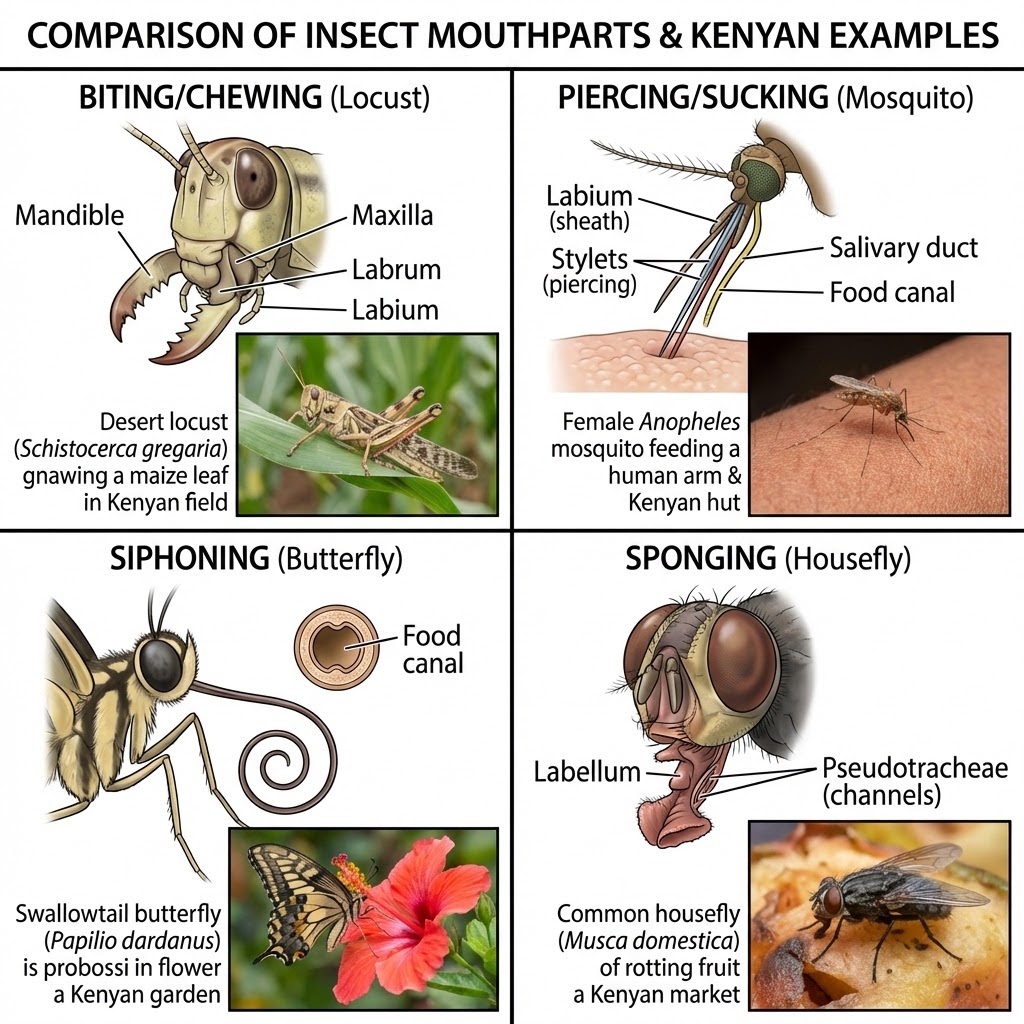
Insects have evolved specialized mouthparts to exploit different food sources. This reduces competition between species.
| Feeding Mode | Insect Example | Structural Adaptation |
|---|---|---|
| Biting & Chewing | Locust, Grasshopper | Strong Mandibles (jaws) for cutting and grinding tough plant tissue. |
| Piercing & Sucking | Mosquito, Bedbug | Mouthparts modified into a needle-like Proboscis to penetrate skin/tissues. |
| Siphoning | Butterfly, Moth | Long, coiled tube (proboscis) to reach nectar deep inside flowers. |
| Sponging/Lapping | Housefly | Fleshy Labellum at the tip to soak up liquefied food. |
| Cutting | Tsetse Fly | Short, sturdy mouthparts used to lacerate skin to reach blood vessels. |
Grade 10 CBE Kenyan Examples & Field Notes:
- Biting & chewing: Locusts/grasshoppers (common in dry grasslands) — major agricultural pests during outbreaks; mandibles adapted for tough maize/sorghum leaves.
- Piercing & sucking: Mosquitoes (malaria vector in Kenya) — females pierce skin for blood meal (protein for eggs); males feed on nectar.
- Siphoning: Butterflies/moths (e.g., African moon moth) — proboscis uncoils to feed on nectar from hibiscus or jacaranda flowers.
- Sponging: Houseflies — regurgitate enzymes onto food (e.g., ugali leftovers) → liquefy → lap up; major disease vectors (typhoid, cholera).
- Field activity: Collect (ethically) or observe live insects → sketch mouthparts under hand lens/microscope → match to feeding mode → discuss ecological role (pollination, pest, decomposer).
- Misconception to correct: "All insects bite humans" — no, only piercing/sucking types feed on blood; most are plant-feeders or nectar-feeders.
🦅 Avian Beaks: Nature's Tools
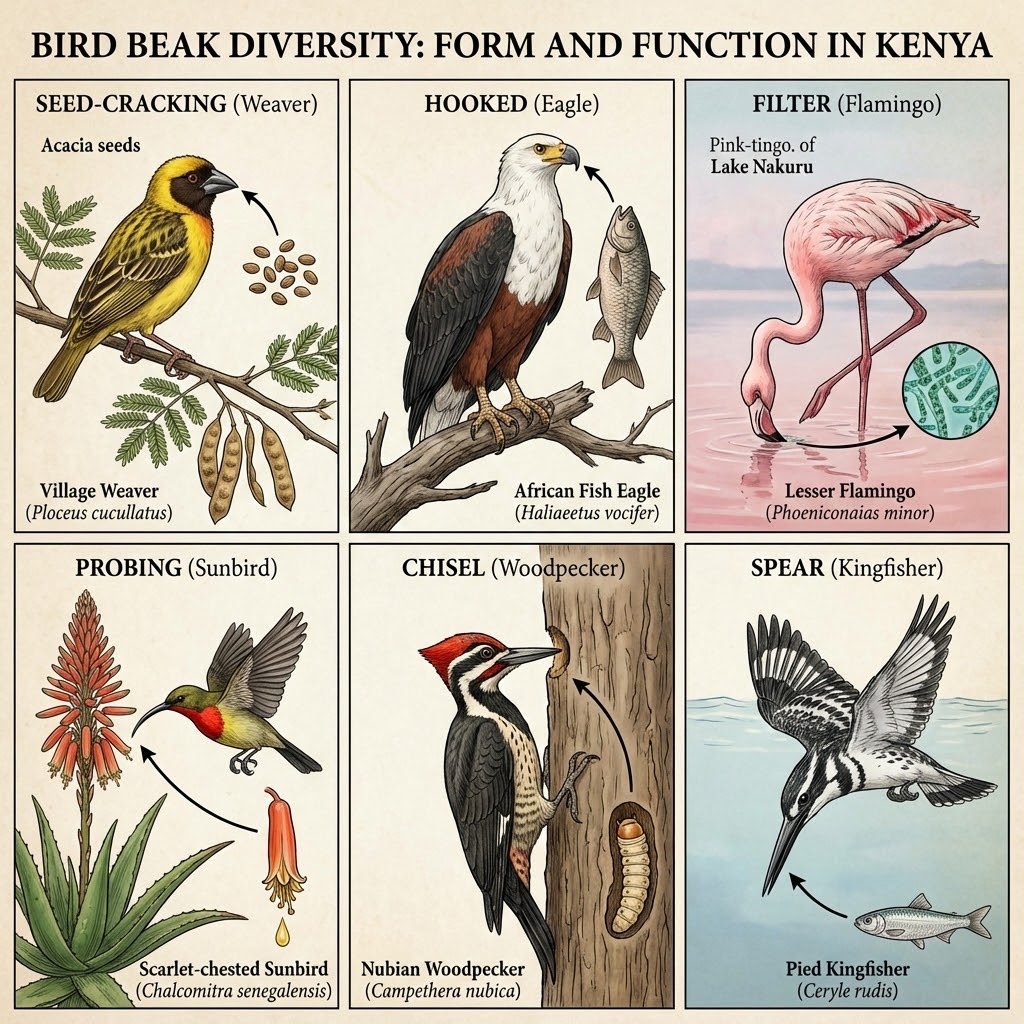
A bird's beak is its primary tool for gathering food. Its shape is a direct indicator of the bird's niche in the ecosystem.
Seed Eaters (e.g., Sparrow): Short, thick, conical beaks for cracking hard shells and husks.
Flesh Eaters (e.g., Eagle/Hawk): Strong, sharp, hooked beaks for tearing meat from prey.
Filter Feeders (e.g., Flamingo/Duck): Broad, flat beaks with comb-like structures (lamellae) to strain food from water/mud.
Nectar Feeders (e.g., Sunbird): Long, slender, curved beaks to probe tubular flowers.
Wood Chippers (e.g., Woodpecker): Strong, chisel-like beaks for hammering into tree trunks to find insects.
Fish Eaters (e.g., Kingfisher): Long, spear-like beaks for stabbing or gripping slippery fish.
Grade 10 CBE Kenyan Examples & Ecological Roles:
- Seed eaters: Weaver birds, quelea (major pest of wheat/rice in Kenya) — conical beaks crack seeds efficiently.
- Flesh eaters: African fish eagle, martial eagle — hooked beaks tear flesh; important for controlling rodent/snake populations.
- Filter feeders: Greater flamingo (Lake Nakuru/Bogoria) — lamellae filter algae/brine shrimp from soda lakes.
- Nectar feeders: Scarlet-chested sunbird, malachite sunbird — long curved beaks pollinate flowers (e.g., aloe, hibiscus).
- Field activity: Birdwatching walk (e.g., Nairobi National Park or school garden) → use binoculars → record beak shape + food source → sketch and classify.
- Misconception to correct: "All birds eat seeds" — no, beak shape is highly specialized; birds show adaptive radiation (diverse feeding niches reduce competition).
🚶 Field Observation & Safety
A nature walk is essential to observe these adaptations in real-time. Follow these Responsible Student guidelines:
- Safety: Do not handle unknown insects; some may sting or bite as a defense mechanism.
- Conservation: Observe birds from a distance using binoculars to avoid disturbing their natural feeding behavior.
- Reporting: Record the bird type, beak shape, and the specific food it was consuming.
Grade 10 CBE Fieldwork & Biodiversity Notes:
- Ethical collection: Use sweep nets or observation only; return insects to habitat; never collect protected species.
- Birdwatching tips: Early morning best (birds active); use local guides/apps (e.g., eBird) → identify species like superb starling, hadada ibis.
- Ecological importance: Insects pollinate crops (bees for coffee/tea), birds control pests (e.g., drongos eat locusts) → biodiversity supports agriculture.
- Misconception to correct: "All insects are pests" — no, most are beneficial (pollinators, decomposers, food for birds).
❓ Inquiry Question
"How do insects and birds feed?"
Answer: They feed through specialized anatomical structures. Insects use modified mouthparts (like mandibles or a proboscis), while birds use beaks shaped by evolution to handle specific food types, such as hooked beaks for meat or chisel beaks for wood.
Answer: They feed through specialized anatomical structures. Insects use modified mouthparts (like mandibles or a proboscis), while birds use beaks shaped by evolution to handle specific food types, such as hooked beaks for meat or chisel beaks for wood.
🧩 Knowledge Check
1. Which insect part is modified into a long coiled tube for siphoning nectar?
2. A bird has a broad, flat beak with lamellae for straining food. What is its feeding mode?