🎯 Learning Outcomes
- Analyse characteristics of respiratory surfaces across the animal kingdom.
- Describe mechanisms of gaseous exchange in insects, fish, amphibians, and mammals.
- Differentiate between Aerobic and Anaerobic respiration and explain Oxygen Debt.
- Calculate the Respiratory Quotient (RQ) for various food substrates.
- Design and build a model to demonstrate mammalian lung ventilation.
- Investigate factors affecting metabolic rates through physical activity.
🫁 Respiratory Surfaces & Adaptations
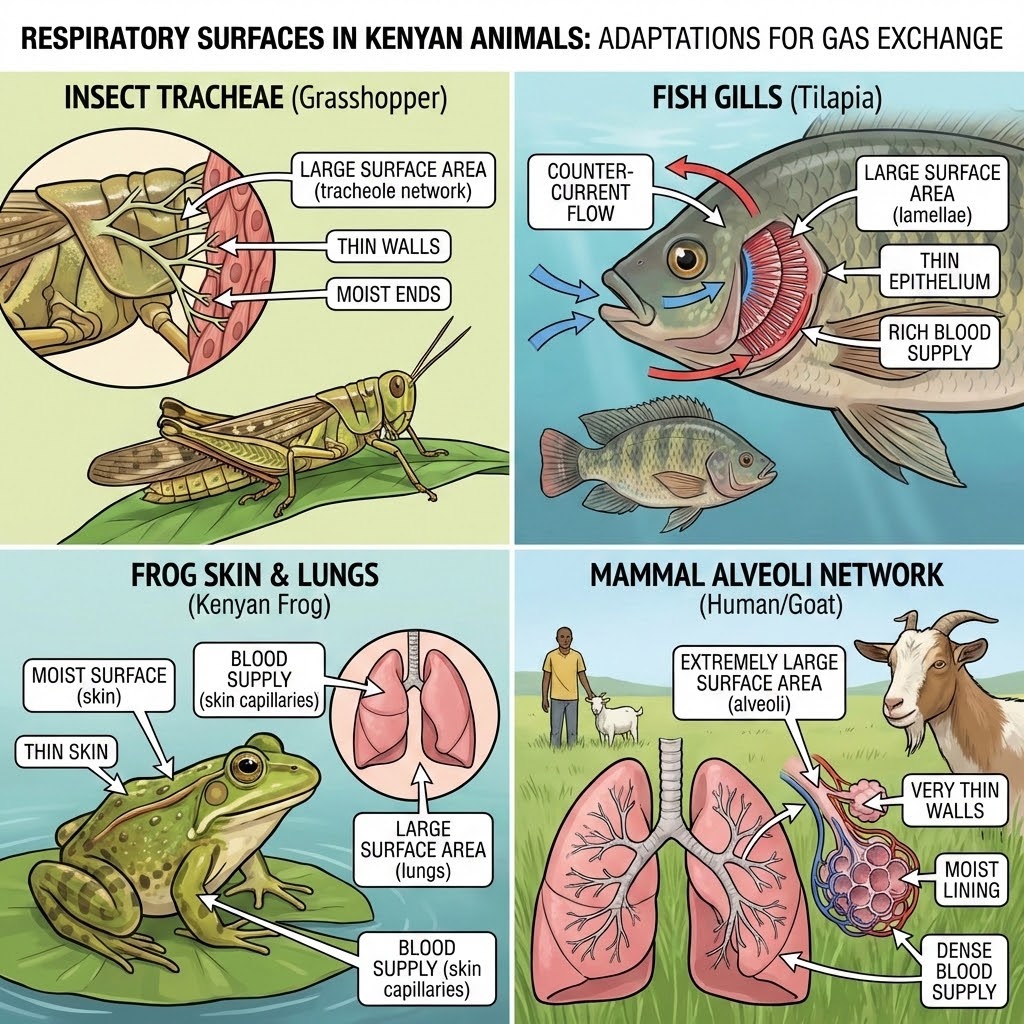
A respiratory surface must be efficient to allow rapid diffusion of gases. All surfaces share these four features:
- Large Surface Area: For maximum gas exchange (e.g., Alveoli, Gill lamellae).
- Thin Membrane: Usually one cell thick to reduce diffusion distance.
- Moist Surface: Gases must dissolve in moisture before diffusing.
- Rich Blood Supply: To maintain a steep concentration gradient (except in insects).
| Animal | Structure | Special Adaptation |
|---|---|---|
| Insects | Tracheal System | Air enters through Spiracles and travels through tracheoles directly to cells. |
| Fish | Gills | Counter-current flow (blood and water flow in opposite directions) maximizes oxygen extraction. |
| Amphibians | Skin / Lungs | Moist, highly vascularized skin allows for exchange while submerged. |
| Mammals | Lungs (Alveoli) | Millions of Alveoli provide a massive internal surface area for oxygen uptake. |
Grade 10 CBE Kenyan Examples & Practical Notes:
- Insects: Grasshoppers, cockroaches, bees — spiracles open/close to control water loss (important in dry Kenyan climate).
- Fish: Tilapia, Nile perch in Lake Victoria — counter-current flow allows ~80–90% oxygen extraction from water.
- Amphibians: Frogs (common in wetlands) breathe through moist skin when in water, lungs when on land.
- Mammals: Humans, goats, cows — alveoli (~300 million in human lungs) give surface area ~70 m² (size of tennis court).
- Lab activity: Dissect insect (grasshopper) → show spiracles/tracheae; fish gill model (plastic bottle + straws); balloon lung model for mammals.
- Misconception to correct: "All animals breathe with lungs" — no, many use gills, skin, tracheae, or book lungs (spiders).
⚡ Metabolism & Oxygen Debt
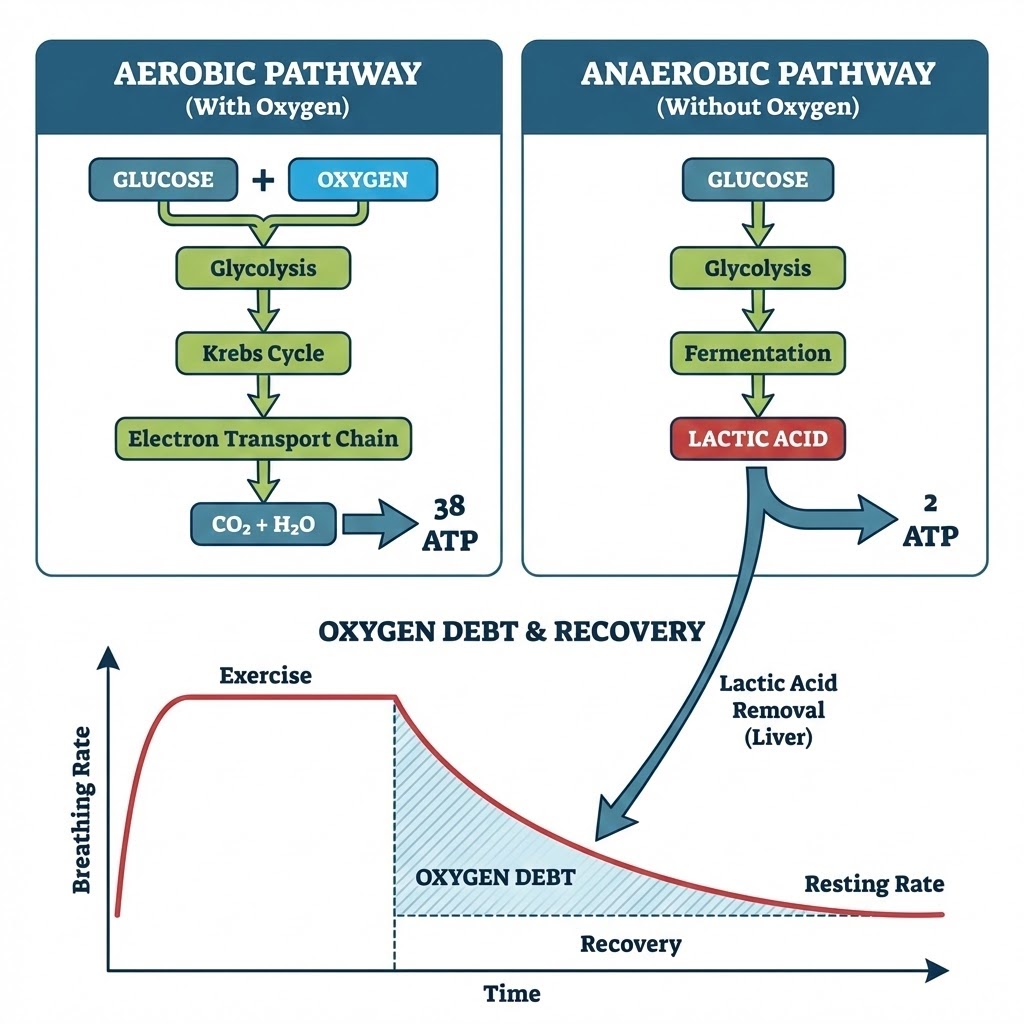
When animals undergo strenuous exercise, Oxygen demand exceeds supply. The body switches to Anaerobic Respiration:
In Mammalian Muscle:
Glucose → Lactic Acid + Energy (2 ATP)
Oxygen Debt: This is the amount of Oxygen required after exercise to break down the accumulated Lactic Acid into CO₂ and Water. This is why we breathe heavily after running.
Glucose → Lactic Acid + Energy (2 ATP)
Oxygen Debt: This is the amount of Oxygen required after exercise to break down the accumulated Lactic Acid into CO₂ and Water. This is why we breathe heavily after running.
Grade 10 CBE Kenyan Context & Practical Notes:
- Aerobic respiration: Glucose + O₂ → CO₂ + H₂O + 38 ATP (most efficient — used during rest/walking).
- Anaerobic in muscle: During sprinting, football, or matatu pushing — lactic acid builds up → muscle fatigue, burning sensation.
- Oxygen debt recovery: Heavy breathing after exercise oxidizes lactic acid → takes minutes to hours (why athletes "cool down").
- Lab activity: Students exercise (star jumps) → measure breathing rate before/after → feel lactic acid "burn" → discuss oxygen debt.
- Misconception to correct: "Anaerobic means no oxygen at all" — no, it means oxygen supply is insufficient; some oxygen is still used, but not enough for full aerobic breakdown.
🧮 Respiratory Quotient (RQ)
The RQ indicates which type of food is being used as a respiratory substrate. It is calculated as:
RQ =
Volume of CO2 produced
Volume of O2 consumed
| Substrate | Typical RQ Value |
|---|---|
| Carbohydrates | 1.0 |
| Proteins | 0.8 - 0.9 |
| Lipids (Fats) | 0.7 |
Grade 10 CBE Practical Notes & Examples:
- RQ = 1.0: Carbohydrates (glucose) — common during normal activity or after eating ugali/posho (maize-based).
- RQ ≈ 0.7: Fats — used during prolonged exercise or fasting (body fat reserves in endurance running or drought conditions).
- RQ ≈ 0.85: Mixed diet (carbs + fats) — typical in Kenyan meals (ugali + beans + sukuma wiki).
- Lab activity: Use respirometer (germinating seeds or small animal) → measure O₂ consumed vs CO₂ produced → calculate RQ → interpret substrate.
- Misconception to correct: "RQ > 1 means something is wrong" — no, RQ > 1 can occur during conversion of carbs to fats (e.g., after overfeeding), but rare in animals.
🏗️ Project: Lung Ventilation Model
Demonstrate how the Diaphragm controls pressure changes to move air:
- Materials: Plastic bottle (rib cage), Balloons (lungs), Rubber sheet (diaphragm), Y-tube (trachea).
- Inhalation: Pulling the rubber sheet down increases volume and lowers pressure, causing balloons to inflate.
- Exhalation: Pushing the sheet up decreases volume and increases pressure, forcing air out.
Grade 10 CBE Extension & Kenyan Context:
- Mechanics: Boyle’s Law — volume ↑ → pressure ↓ → air rushes in (inhalation); volume ↓ → pressure ↑ → air forced out (exhalation).
- Real life: Asthma (common in Nairobi due to pollution/dust) → narrowed airways increase resistance → harder to exhale.
- Activity tip: Students build model → label parts (diaphragm, ribs, lungs) → demonstrate forced breathing (exercise) vs quiet breathing.
- Misconception to correct: "Lungs actively pull air in" — no, lungs are passive; diaphragm and intercostal muscles do the work.
❓ Inquiry Question
"How does gaseous exchange occur in animals?"
Answer: It occurs through simple diffusion across a specialized respiratory surface. For diffusion to be effective, the animal must maintain a concentration gradient—often through ventilation (breathing) and a circulatory system that whisks oxygen away from the exchange site.
Answer: It occurs through simple diffusion across a specialized respiratory surface. For diffusion to be effective, the animal must maintain a concentration gradient—often through ventilation (breathing) and a circulatory system that whisks oxygen away from the exchange site.
🧩 Knowledge Check
1. After a sprint, a runner continues to breathe deeply. What is the body "paying back" during this time?
2. If a food substrate produces 102 molecules of CO₂ for every 145 molecules of O₂ used, what is the RQ? (Round to one decimal)